Export Logistics · Guide
Every commercially significant port in India, with FY 2025–26 data, drafts, port codes and a decision framework for choosing your port of loading.
Last updated: July 2026 · Reading time: 14 minutes
Search the term and you will find the same article thirty times. A numbered list. Twelve or thirteen ports. A sentence each. A stock photo of a gantry crane.
None of it answers the only question that matters when you are actually moving a container: which port should this shipment leave from, and what will it cost me in days and dollars if I choose wrong?
That question has real answers. A consignment of nitrile gloves from a Rajkot factory does not belong on a truck to Chennai. A wound-care shipment to Auckland routed through Kolkata will sit waiting for a feeder for eleven days. A buyer in Banjul asking for CIF Banjul needs to understand that the transshipment leg through Jebel Ali or Colombo is where most of his transit variance lives.
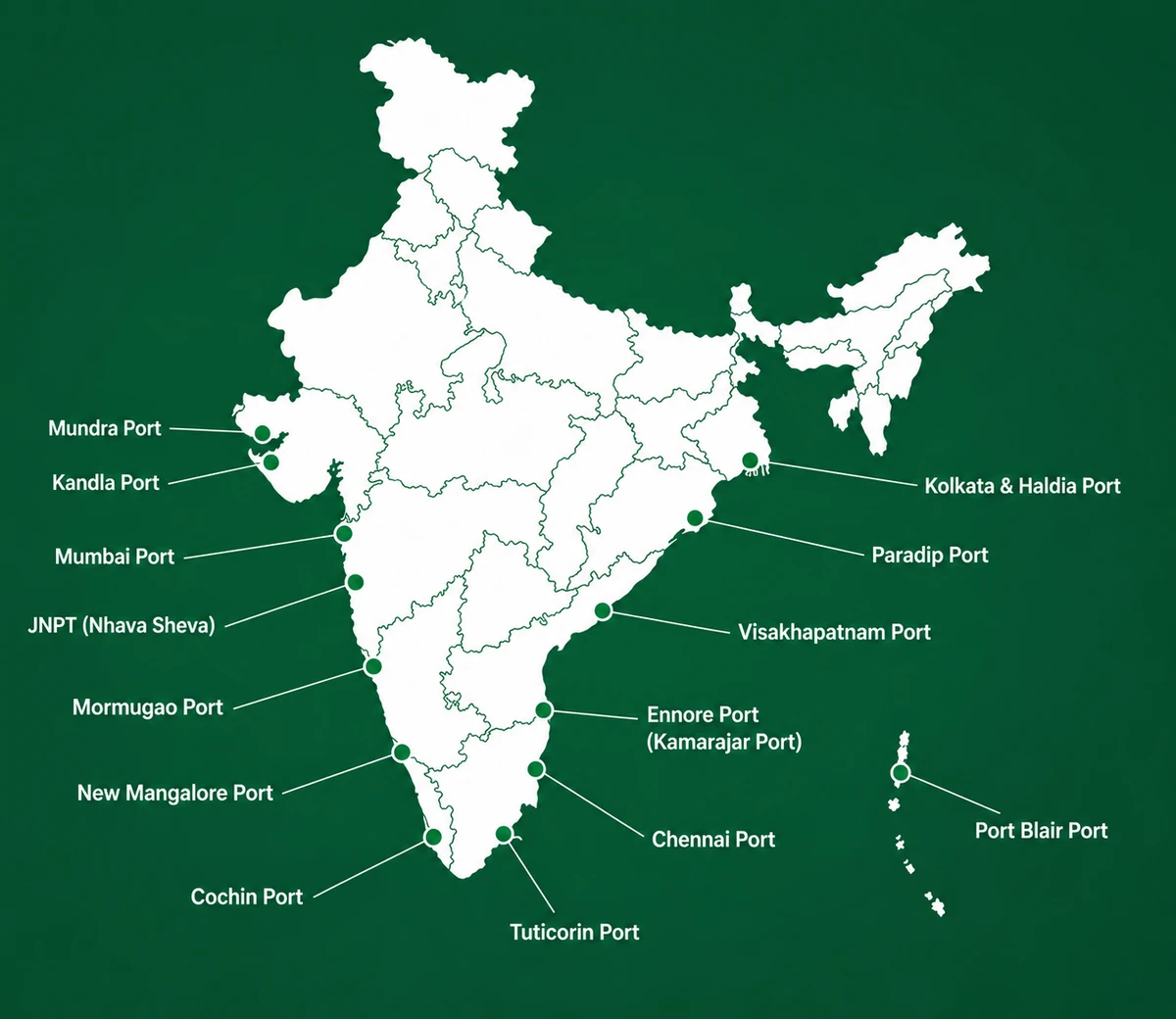
This guide covers every commercially significant port in India — the twelve major ports, the non-major ports that actually matter for containerised trade, and the three greenfield projects that will reshape the map before 2030. For each, you get draft, cargo specialisation, hinterland reach and the practical answer to whether your cargo belongs there.
It is written from the loading side. We ship from these ports.
Before the port-by-port breakdown, you need the administrative vocabulary, because it determines who you negotiate with and which tariff applies.
India has 12 major ports and roughly 200 non-major ports. “Major” is a legal classification, not a ranking. Major ports fall under the central government — the Ministry of Ports, Shipping and Waterways (MoPSW) — and are governed by the Major Port Authorities Act, 2021. Non-major ports fall under state maritime boards.
The confusion this creates is significant, and it trips up first-time importers constantly:
Mundra is not a major port. Mundra is India’s largest port.
It is privately operated by Adani Ports and SEZ (APSEZ) and sits under the Gujarat Maritime Board. By tonnage it exceeds every centrally-administered port in the country. Vizhinjam, Pipavav, Hazira, Krishnapatnam, Dhamra, Kattupalli — all non-major, all serious infrastructure.
So when a competitor’s article tells you “India’s biggest port is Deendayal,” what they mean is “India’s biggest major port is Deendayal.” Deendayal handled 160.11 MT in FY 2025–26 and topped the major-port league table. Mundra handled more.
Most Indian ports now operate on a landlord model: the port authority owns the land and the marine assets, and private terminal operators hold concessions to run individual berths. This is why you will find DP World, PSA, APM Terminals, MSC’s Terminal Investment Limited and J M Baxi operating terminals inside government ports.
Practically, it means berth productivity varies within a single port. The container terminal at JNPA operated by one concessionaire may deliver a materially different crane rate than the terminal next door. When your freight forwarder quotes a berth, ask which terminal.
The Indian Ports Act, 2025 replaced the 1908 Act — a genuine milestone, given the previous statute predated Indian independence by four decades. Alongside the Major Port Authorities Act 2021, Sagarmala, and the Maritime Amrit Kaal Vision 2047, the direction of travel is greater terminal autonomy, more PPP participation, and standardised state–centre coordination.
For exporters, the operationally relevant consequence has been turnaround time. Average vessel turnaround at major ports has fallen from roughly 127 hours in 2010–11 to under 50 hours by FY26. Whatever the precise measure, the direction is unambiguous, and it means berth congestion is no longer the default assumption when building a shipment timeline.
| Metric | FY 2025–26 |
|---|---|
| Major ports cargo | 915.17 MT (target: 904 MT) |
| YoY growth, major ports | 7.06% |
| All-India total cargo | ~1,600 MT |
| Non-major share of total | ~43% |
| Top major port | Deendayal (Kandla) — 160.11 MT |
| Second | Paradip — 156.45 MT |
| Third | JNPA (Nhava Sheva) — 102.01 MT |
| Fastest-growing major port | Mormugao — +15.91% |
| Largest container port | Mundra |
| Largest transshipment port | Vizhinjam |
| Number of major ports | 12 |
| Number of non-major ports | ~200 |
Two structural facts sit underneath these numbers.
First, containers are growing faster than bulk. Bulk tonnage flatters the league table — Deendayal and Paradip are large because coal, POL and fertiliser are heavy. If your cargo is containerised, tonnage rankings are a poor proxy for relevance. Container throughput is the number to watch, and there JNPA and Mundra dominate.
Second, the non-major ports are not a footnote. They handle close to half of India’s cargo. Any guide that lists twelve ports and stops has hidden half the country’s capacity from you.
The west coast serves Europe, the Middle East, Africa’s Atlantic and Mediterranean coasts, and — via Suez — the UK and northern Europe. If you are exporting to the UK, Nigeria, The Gambia, Kenya, the Gulf, or Russia via the INSTC corridor, your cargo almost certainly leaves from here.
Port code: INMUN1 · Operator: APSEZ (private) · Type: Non-major
India’s largest port by cargo volume and its largest container port, handling roughly a third of national container traffic. Deep, all-weather, berthing-on-arrival, in the Gulf of Kutch.
Draft. Deep-water, capable of accommodating fully laden Capesize vessels and the largest container ships currently trading. Mundra set a national record of 3,234 TEU handled in a single day.
Cargo profile. Genuinely multi-purpose. Containers, coal, crude (via SPM), fertiliser, chemicals, automobiles, agri bulk. India’s first port-based multi-product SEZ.
Hinterland. Exceptional. 117 km of private rail network, double-stack container rakes, direct connectivity into the Western Dedicated Freight Corridor. This is why Mundra works for cargo originating anywhere in Gujarat, Rajasthan, Delhi NCR, Punjab and Haryana.
When to use it. Almost any westbound container from north or west India. Best-in-class crane productivity, dense sailing schedules to Europe, the Gulf and East Africa.
When not to. If your factory is in Tamil Nadu or Andhra Pradesh, the inland haul destroys the advantage.
Port code: INNSA1 · Type: Major
India’s premier container gateway and the port most overseas buyers have actually heard of. Handled 102.01 MT in FY 2025–26, growing 10.74%, and moves over half of India’s container traffic — around 7.9 million TEU.
Draft. Approximately 15 m at the deepest terminals following channel deepening. Handles large gearless container vessels but not the newest ultra-large classes at full load — precisely the gap Vadhvan is being built to close.
Cargo profile. Overwhelmingly containerised. General cargo, textiles, pharmaceuticals, chemicals, engineering goods, consumer products.
Hinterland. Pune, Nashik, Aurangabad, Nagpur, Indore, Bhopal, and the Delhi NCR corridor via the DFC. Extensive network of Container Freight Stations (CFS) and Inland Container Depots (ICD).
When to use it. Default for exporters based in Maharashtra and central India. Widest carrier choice of any Indian port. If your buyer specifies a niche destination port, JNPA is the most likely to have a direct or single-transshipment service.
Operational note
JNPA’s Direct Port Delivery (DPD) and Direct Port Entry (DPE) schemes can strip two to four days off dwell time for approved exporters. If you ship regular volume through Nhava Sheva and are not DPE-registered, you are paying a time tax for no reason.
Port code: INIXY1 · Type: Major
Top-ranked major port by tonnage: 160.11 MT in FY 2025–26. A tidal port in the Gulf of Kutch.
Cargo profile. Bulk-dominant. POL, chemicals, edible oil, fertiliser, salt, timber, iron and steel. Container volumes exist but are modest relative to Mundra next door.
When to use it. Liquid bulk, edible oil, dry bulk and project cargo out of Gujarat and the northern hinterland. For containers, Mundra is the better answer in almost every case.
Port code: INBOM1 · Type: Major
The historic port, now substantially repositioned. Container traffic migrated to JNPA decades ago. Mumbai Port today handles liquid bulk, break bulk, steel, and an expanding cruise business, with a large portion of its estate being redeveloped for the city. Use it for break bulk and project cargo; rarely the right answer for containerised FMCG.
Port code: INMRM1 · Type: Major
The fastest-growing major port in FY 2025–26 at +15.91%. Historically iron-ore driven; the recovery reflects a rebound in mineral exports plus diversification into coal, containers and coastal cargo. Use it for iron ore and mineral bulk. A modest but real coastal shipping node.
Port code: INNML1 · Type: Major
Deep-draft, all-weather. Handles POL, LPG, edible oil, containers, iron ore pellets, cashew, coffee, granite and timber. Serves Karnataka’s hinterland — Bengaluru, Mangaluru, Hubballi. Use it for cargo originating in coastal or interior Karnataka where the haul to Mundra or JNPA is uneconomic. Growing container connectivity, but with fewer direct services — expect transshipment through Colombo or Jebel Ali.
Port code: INCOK1 · Type: Major
Natural harbour on the Malabar coast. Home to the International Container Transshipment Terminal at Vallarpadam, plus a significant LNG terminal, ship-repair yard and bunkering business. Handles containers, POL, LNG, fertiliser, spices, seafood, cashew, rubber and coir. Use it for Kerala-origin cargo. Vallarpadam offers transshipment but has historically been undercut by Colombo; Vizhinjam changes that calculus.
Port code: INTRV1 · Operator: Adani Vizhinjam Port Pvt Ltd (49% MSC/TiL, July 2026) · Type: Non-major
The most important new port in India, and the one your competitors’ articles have not caught up with.
Why it matters. Roughly 75% of India’s transshipment cargo has historically been routed through Colombo, Singapore or Jebel Ali — a foreign-exchange leak and an added transit leg on nearly every Indian export to a secondary destination. Vizhinjam exists to repatriate that traffic.
Draft. Natural depth of 20–24 m with negligible littoral drift, requiring essentially no capital dredging. It sits 10 nautical miles from the east–west shipping lane connecting Europe, the Persian Gulf and the Far East.
Status. Phase 1 commercial operations began December 2024; formally inaugurated May 2025. Phase 1 capacity 1 million TEU. In its first year it handled 1.3 million TEU and 615 vessels; it crossed 2 million TEU within 18 months. Phases 2 and 3 are cleared and will raise capacity toward 3 million TEU by 2028.
Vessel capability. India’s first port to handle ultra-large container vessels routinely. MSC Irina (24,346 TEU) called in June 2025.
The MSC deal. In July 2026, MSC’s terminal arm Terminal Investment Limited acquired a 49% stake in Adani Vizhinjam Port — reported as the largest foreign private investment in Indian port infrastructure. Read that as the world’s largest container line committing its network to the port.
When to use it. Right now, mostly as a transshipment node rather than a port of loading — your cargo will pass through Vizhinjam rather than originate there. But for buyers in Africa, the Gulf and the Mediterranean, a Vizhinjam transshipment instead of a Colombo transshipment typically means fewer handling touches and less schedule variance. Ask your forwarder which hub the routing uses. Few exporters are asking the question yet.
Port code: INPAV1 · Type: Non-major
India’s first private port. Containers, dry bulk, liquid, RoRo (a significant automobile export gateway). Strong DFC rail linkage. A credible alternative to Mundra for Gujarat- and Rajasthan-origin containers, particularly if Maersk is your carrier. Often less congested.
Port code: INHZA1 · Type: Non-major
Deep-draft, adjacent to the Surat industrial belt. Containers, steel, LNG, agri bulk, RoRo. Use it for textiles, diamonds and chemicals originating around Surat, where the short haul beats Mundra’s superior connectivity.
Dahej and Magdalla are chemical, LNG and liquid-bulk specialists — relevant if you move hazardous or liquid cargo, not container gateways. Jaigarh and Dighi in Maharashtra serve bulk and coastal traffic. Watch Jaigarh: its deep draft and JSW backing give it long-term container potential.
The east coast serves East and Southeast Asia, the Far East, Australia and New Zealand, and — via the Strait of Malacca or around the Cape — the US east coast. If you are exporting to Auckland, Singapore, Bangkok or Shanghai, the east coast is usually shorter.
Port code: INPRT1 · Type: Major
The second-largest major port: 156.45 MT in FY 2025–26. Deep-water berths around 16.5 m draft, able to handle Capesize vessels. Coal, iron ore, POL, fertiliser, and the highest coastal-shipping volume among major ports; captive jetties serve steel producers. Mineral bulk out of Odisha, Jharkhand and Chhattisgarh. Not a container play.
Port code: INVTZ1 · Type: Major
A deep, natural, protected harbour — arguably India’s best natural port geography. Iron ore, coal, POL, fertiliser, alumina, containers and general cargo. Use it for cargo from Andhra Pradesh, Telangana and eastern Madhya Pradesh. Reasonable container connectivity to Southeast Asia.
Port code: INMAA1 · Type: Major
An artificial harbour, and the east coast’s flagship container gateway. Automobiles (Chennai is India’s automotive export hub), containers, general cargo. Coal and iron ore have been progressively shifted out to Kamarajar for environmental reasons.
When to use it. Container exports from Tamil Nadu — textiles, leather, auto components, engineering goods. Best east-coast carrier choice for Southeast Asia, the Far East and Australasia.
Constraint. Landlocked inside the city. Road congestion is a real and recurring cost. Evacuation is the bottleneck, not the berth.
Port code: INENR1 · Type: Major
Built to relieve Chennai. Coal, automobiles (RoRo), LNG, and increasingly containers. India’s first corporatised major port. Use it for automobile RoRo exports and thermal coal; a growing container option worth quoting alongside Chennai.
Port code: INTUT1 · Type: Major
An underrated container port and India’s most technologically progressive, having become the first major port to implement a digital twin (March 2026) and having piloted AI-driven congestion forecasting and just-in-time berthing with IIT Madras. Containers, coal, fertiliser, salt, sugar, cement, agri products. Notably good for agri, salt and textile exports out of southern Tamil Nadu, often with shorter dwell times than Chennai.
Port codes: INCCU1 (Kolkata Dock System), INHAL1 (Haldia Dock Complex) · Type: Major
India’s only major riverine port, roughly 200 km up the Hooghly. Grew 14.28% in FY 2025–26 at the Kolkata Dock System.
The fundamental constraint. Draft. The Hooghly requires continuous dredging and imposes tidal windows. Vessel sizes are limited. Haldia, downstream, is deeper and takes the larger ships.
When to use it. Cargo from West Bengal, Bihar, Jharkhand, Assam, and the northeast — and transit cargo for Nepal and Bhutan, for which Kolkata is the natural gateway.
When not to. Time-critical shipments to distant destinations. The draft restriction means feeder vessels and a transshipment leg, usually via Colombo, Port Klang or Singapore. Add days and add variance.
Krishnapatnam (INKRI1, APSEZ) — deep-draft, mechanised, high-throughput; recorded its highest-ever monthly volume of 5.85 MT in June 2025. Bulk out of Andhra Pradesh and Telangana; a growing container alternative to Chennai with less congestion.
Dhamra (INDHA1, APSEZ) — very deep draft (18+ m), Capesize-capable. Coal, iron ore, limestone, LNG. Heavy mineral bulk, not containers.
Kattupalli (INKAT1, APSEZ) — containers and automobiles, north of Chennai. A serious alternative for Tamil Nadu exporters who want to avoid Chennai city traffic.
Gopalpur, Kakinada and Karaikal — second-tier non-major ports serving regional bulk, fertiliser and agri traffic. Relevant for specific commodity flows, rarely for containers.
Three greenfield projects deserve attention because they will alter routing decisions within the working life of most current supply contracts.
Palghar district, roughly 140 km north of Mumbai. Natural depth around 20 m.
Vadhvan is the answer to JNPA’s draft ceiling. It will accommodate the ultra-large vessels JNPA cannot, and it sits at the intersection of the India–Middle East–Europe Economic Corridor (IMEEC) and the International North–South Transport Corridor (INSTC). If you ship to Russia via the INSTC, or to Europe via IMEEC, Vadhvan is the port your five-year logistics plan should assume.
Approximately ₹44,000 crore, 16.2 million TEU at full build, in two phases (Phase 1: ₹18,000 crore, 4 million TEU). It sits 40 nautical miles from the Malacca Strait, through which roughly a third of global trade passes.
Cleared by the PPP Appraisal Committee in March 2026 for development by a JV — 55% Indian-controlled, 45% state-owned ports including Kamarajar. Foreign operators excluded. Fifty-year concession with viability gap funding.
Galathea is a strategic play against Singapore and Port Klang, not a gateway port. No exporter will load cargo there. But if it works, Indian cargo bound for East Asia stops paying a Singapore transshipment premium.
Capacity to roughly 3 million TEU by 2028, up to 5.7 million TEU operational throughput at completion, capable of handling five mother vessels simultaneously and next-generation vessels up to 28,000 TEU.
Forget the rankings. Work through these five questions in order.
Inland haulage is usually the largest controllable cost in an FOB shipment and the largest source of transit variance. A 1,400 km truck run from Ludhiana to Nhava Sheva costs more and carries more risk than the rail leg to Mundra. Start with the factory, not the port.
| Origin region | Primary port | Secondary |
|---|---|---|
| Punjab, Haryana, Delhi NCR | Mundra | Pipavav, JNPA |
| Rajasthan | Mundra | Pipavav |
| Gujarat (north / Kutch) | Mundra | Deendayal |
| Gujarat (south / Surat) | Hazira | Mundra |
| Maharashtra | JNPA | Mundra |
| Madhya Pradesh | JNPA | Mundra |
| Karnataka | New Mangalore | JNPA |
| Kerala | Cochin | Tuticorin |
| Tamil Nadu (north) | Chennai | Kattupalli, Kamarajar |
| Tamil Nadu (south) | Tuticorin | Cochin |
| Andhra Pradesh, Telangana | Krishnapatnam | Visakhapatnam, Chennai |
| Odisha, Jharkhand | Paradip | Dhamra, Haldia |
| West Bengal, Bihar, NE India | Haldia / Kolkata | Visakhapatnam |
This eliminates most of the list immediately.
| Cargo type | Ports that matter |
|---|---|
| Containers (LCL/FCL) | Mundra, JNPA, Chennai, Tuticorin, Cochin, Krishnapatnam, Kattupalli, Pipavav, Hazira |
| Transshipment | Vizhinjam, Cochin (Vallarpadam) |
| Dry bulk (coal, ore) | Paradip, Deendayal, Dhamra, Visakhapatnam, Mormugao |
| Liquid bulk / chemicals | Deendayal, Dahej, Mumbai, New Mangalore, Hazira |
| RoRo / automobiles | Kamarajar, Chennai, Pipavav, Mumbai |
| Project / break bulk | Mumbai, Kandla, Visakhapatnam |
Direct services beat transshipment every time. Every additional handling event is an additional opportunity for damage, delay, or a demurrage clock you did not budget for.
West-coast preference: UK, Europe, West and East Africa, Gulf, Russia (via INSTC or Suez).
East-coast preference: Southeast Asia, Far East, Australia, New Zealand.
Either: US east coast, Mediterranean, Latin America — check actual sailing schedules rather than assuming.
For UK-bound cargo out of India, Mundra and JNPA both offer direct or single-transshipment services to Felixstowe, Southampton and London Gateway. For New Zealand, the east coast plus a Singapore or Port Klang transshipment is the standard routing; there is no economical direct service.
Under FOB, you pay to get cargo onto the vessel and the buyer chooses the carrier and pays freight. Under CIF/CFR, you choose. Under DDP, you own the entire chain including destination customs.
If you sell FOB, port selection is partly negotiated with the buyer, because their nominated carrier may not call at your preferred port. Raise this at the quotation stage, not after the PI is signed. Nothing sours a first shipment faster than discovering the buyer’s carrier does not call at your loading port.
Ocean freight is the number everyone quotes. It is often not the number that decides. Build a landed-cost model containing, at minimum:
The gap between two ports on ocean freight is frequently smaller than the gap on inland haulage and detention exposure. Quote the whole chain.
Every Indian customs location has a six-character UN/LOCODE-derived port code that appears on your shipping bill, bill of lading and every downstream document. Getting it wrong causes rejected filings and delayed clearance.
Format: IN + three characters for the location + one alphanumeric for the specific facility.
| Port | Code |
|---|---|
| Nhava Sheva (JNPA) | INNSA1 |
| Mundra | INMUN1 |
| Kandla (Deendayal) | INIXY1 |
| Mumbai | INBOM1 |
| Pipavav | INPAV1 |
| Hazira | INHZA1 |
| Chennai | INMAA1 |
| Kamarajar (Ennore) | INENR1 |
| Tuticorin | INTUT1 |
| Cochin | INCOK1 |
| Visakhapatnam | INVTZ1 |
| Paradip | INPRT1 |
| Kolkata | INCCU1 |
| Haldia | INHAL1 |
| Mormugao | INMRM1 |
| New Mangalore | INNML1 |
| Krishnapatnam | INKRI1 |
| Dhamra | INDHA1 |
| Kattupalli | INKAT1 |
India has 12 major ports administered by the central government and approximately 200 non-major ports under state maritime boards. Roughly a dozen non-major ports handle commercially significant international traffic.
By total cargo volume, Mundra Port in Gujarat — privately operated by APSEZ, and a non-major port administratively. Among the 12 major ports, Deendayal Port (Kandla) ranked first in FY 2025–26 at 160.11 million tonnes.
Mundra handles the largest container volume overall and roughly a third of national container traffic. JNPA (Nhava Sheva) is the largest major port for containers, moving over half of India’s container traffic at approximately 7.9 million TEU.
Vizhinjam International Seaport in Kerala. Commercial operations began in December 2024. It has a natural draft of 20–24 m, sits 10 nautical miles from the east–west shipping lane, and handled 1.3 million TEU in its first year.
For most cargo, Mundra or JNPA (Nhava Sheva). Both offer direct or single-transshipment services to Felixstowe, Southampton and London Gateway. Choose based on where your goods originate.
West coast — Mundra or JNPA. East and Southern African destinations typically transship at Jebel Ali, Salalah, or increasingly Vizhinjam. West African destinations such as Banjul, Lagos and Tema generally route via a Mediterranean or European hub.
East coast — Chennai, Kattupalli or Krishnapatnam — with transshipment via Singapore or Port Klang. Direct services are rare and generally uneconomic.
It is administrative, not a measure of size. Major ports are governed by the central government under the Major Port Authorities Act, 2021. Non-major ports fall under state maritime boards. Mundra, India’s largest port, is a non-major port.
Direct Port Delivery allows approved importers to move containers straight from the port to their premises without an intermediate CFS stop, cutting dwell time by several days. Direct Port Entry (DPE) is the export equivalent.
For a routine export shipment with correct documentation, typically 24 to 72 hours. Restricted goods, drawback claims, or a mismatch between the shipping bill and the invoice extend this materially. Average vessel turnaround at major ports is now under 50 hours, down from around 127 hours in 2010–11.
If you are exporting containerised goods from north or west India, use Mundra. From Maharashtra or central India, use JNPA. From Tamil Nadu, use Chennai or Tuticorin. From Kerala, use Cochin. Everything else is a specialist case with a specialist answer.
But the more useful takeaway is this: port selection is a routing decision, not a geography decision. It is settled by hinterland connectivity, sailing schedule, draft and Incoterm — not by which port is largest.
Any supplier who cannot explain why your cargo is leaving from the port it is leaving from has not thought about your shipment. They have thought about their own convenience.
Cargo figures are from the Ministry of Ports, Shipping and Waterways FY 2025–26 release (April 2026) and port-authority disclosures. Vizhinjam and Vadhvan project data reflect announcements current to July 2026. Port codes should be verified against the current CBIC customs location list. This page is reviewed quarterly.
Last updated: 10 July 2026
Villa No. 3, Symphony Cooperative Housing Society Ltd, Fatona, Seraulim, Colva, Goa 403708